Tourmaline
One mineral, almost every colour — a rainbow grown slowly inside the earth.
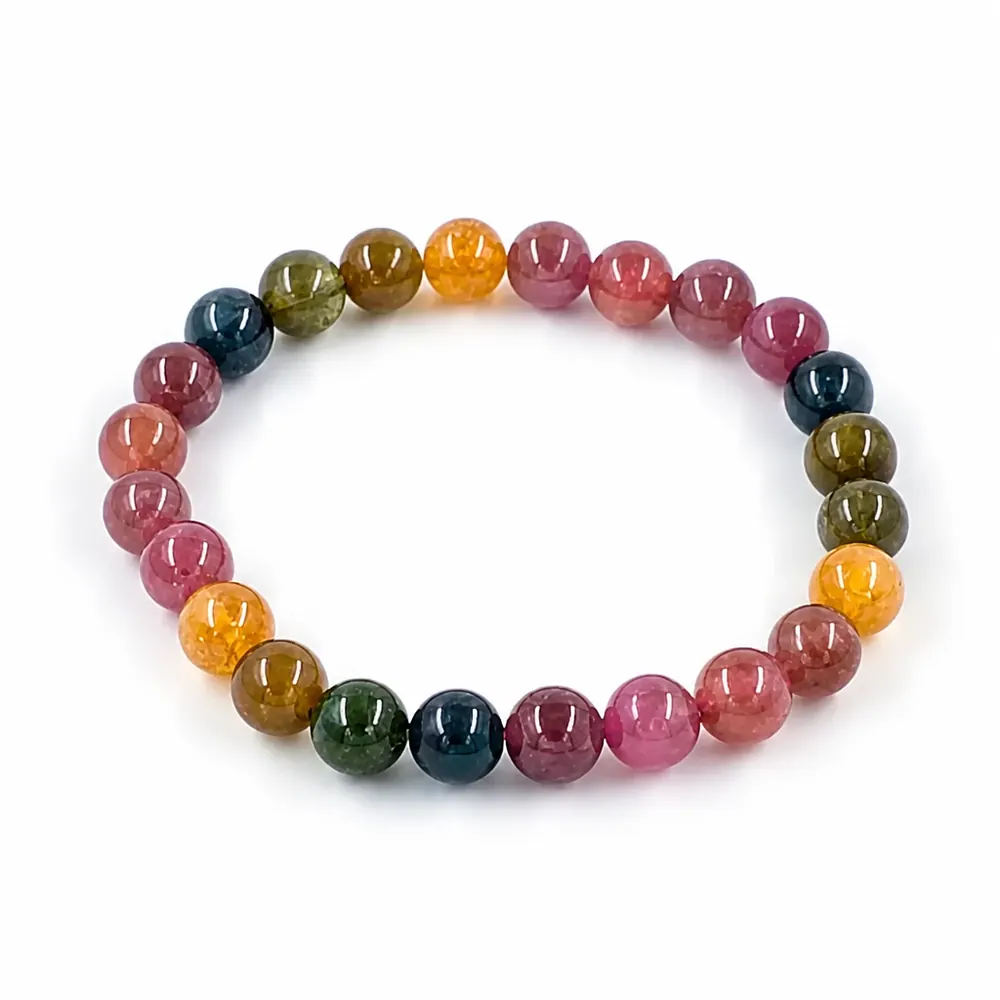
Few stones come in as many colours as tourmaline, and no two beads are ever quite alike. Here is what it is, how to judge a strand, and how to look after it.
At a Glance
- Mineral family
- Tourmaline group (borosilicate)
- Hardness
- 7–7.5 Mohs
- Optical effect
- Colour zoning, pleochroism
- Colour range
- Pink, red, green, blue, gold, black
- Found in
- Brazil, Madagascar, Afghanistan, Nigeria
What It Is
Tourmaline is not one mineral but a family of closely related borosilicates. Tiny changes in the elements present as a crystal grows — manganese for pink, iron for blue and green, chromium for deeper greens — produce one of the widest colour ranges of any gemstone.
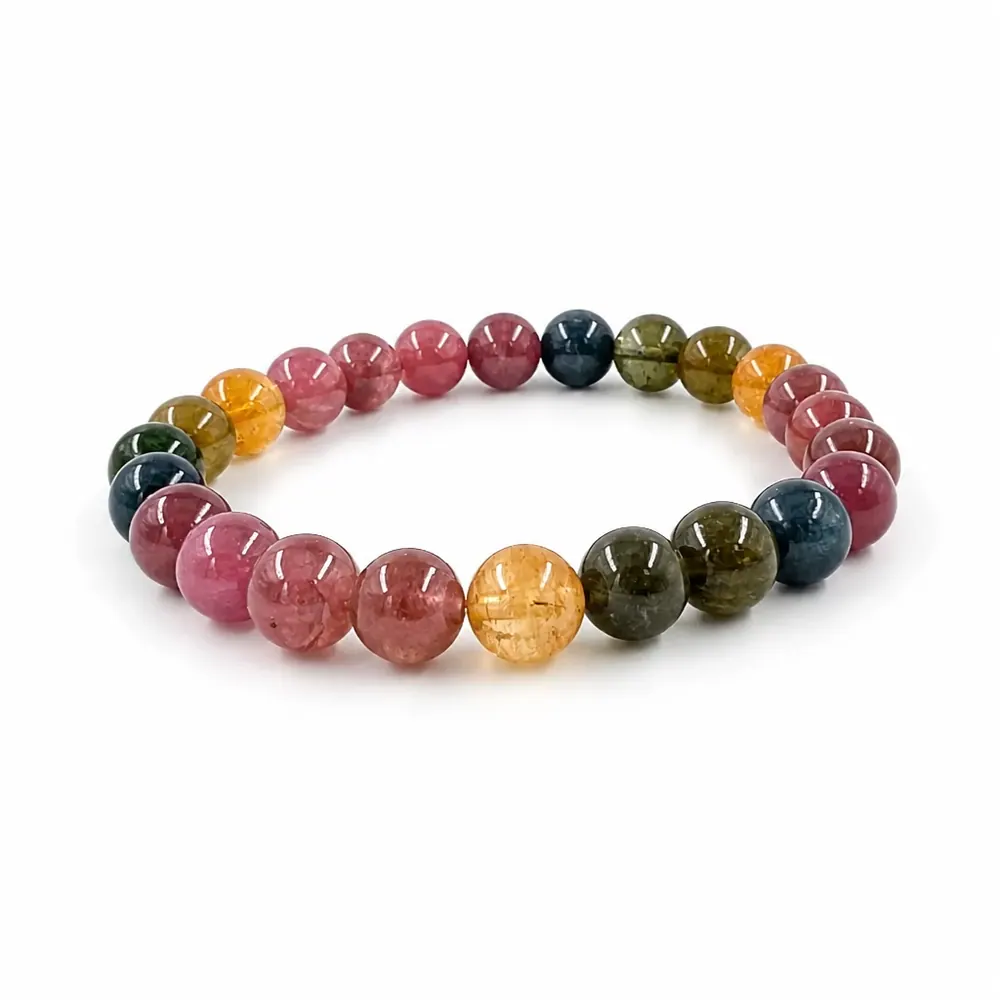
Because those conditions shift during growth, a single crystal can change colour along its length. This is called colour zoning, and it is why a rainbow tourmaline bracelet holds rose, gold, olive and indigo in one strand, all entirely natural.
The Names of Tourmaline
The trade gives each colour its own name: rubellite for pink to red, verdelite for green, indicolite for blue, schorl for black, and watermelon tourmaline for a pink centre ringed in green.
Tourmaline also has an unusual physical quality: warmed or pressed, it develops a small electric charge. Dutch traders once used it to draw ash from their pipes — a curious footnote to a very beautiful stone.
How to Recognise Quality
Colour
Look for clear, saturated colour rather than muddy or greyish tones. In a rainbow strand, the shades should feel balanced across the bracelet, not bunched together.
Clarity
Tourmaline often carries small natural fractures. A few are normal and honest; better beads let light travel through, especially in pink and green.
Natural, not dyed
Real tourmaline varies bead by bead. Strands where every colour is unnaturally bright and identical may be dyed quartz or glass.
Cut and finish
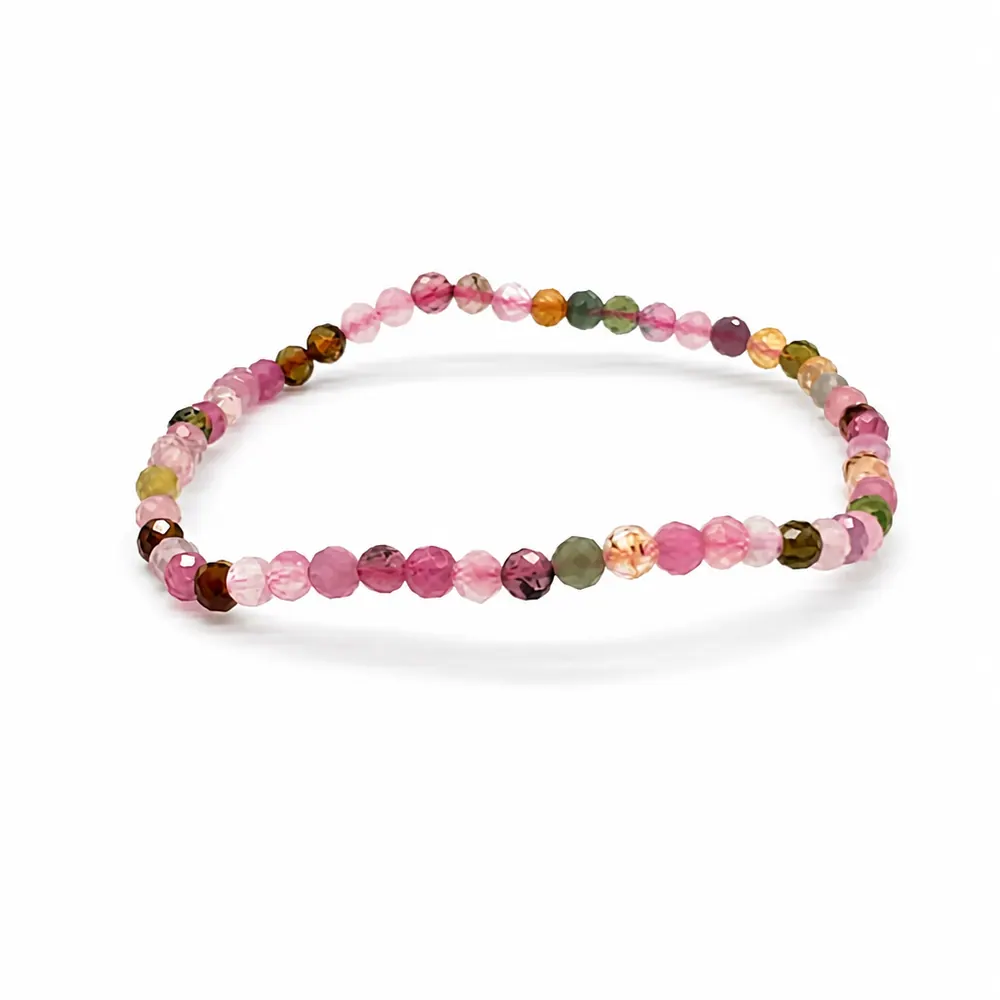
Even polish and clean drill holes. Faceted beads should have crisp, even facets that scatter light rather than look frosted.
In the Crystal Tradition
Tourmaline is associated with steadiness and balance, each colour carrying its own mood:
- Grounding — black and darker tourmaline is often reached for when a day feels scattered.
- Balance — rainbow tourmaline, holding many colours at once, is read as a symbol of holding the whole range of a day.
- Vitality — green tourmaline is associated with freshness and renewal.
- Warmth — pink tourmaline is linked with gentleness and open-heartedness.
Wearing & Pairing
Tourmaline is the rare stone that reads warm and cool at once, so it sits happily beside both silver and gold. Fine 3–4mm strands are made for layering; larger 7.5mm beads show the colour zoning clearly and are best worn alone.
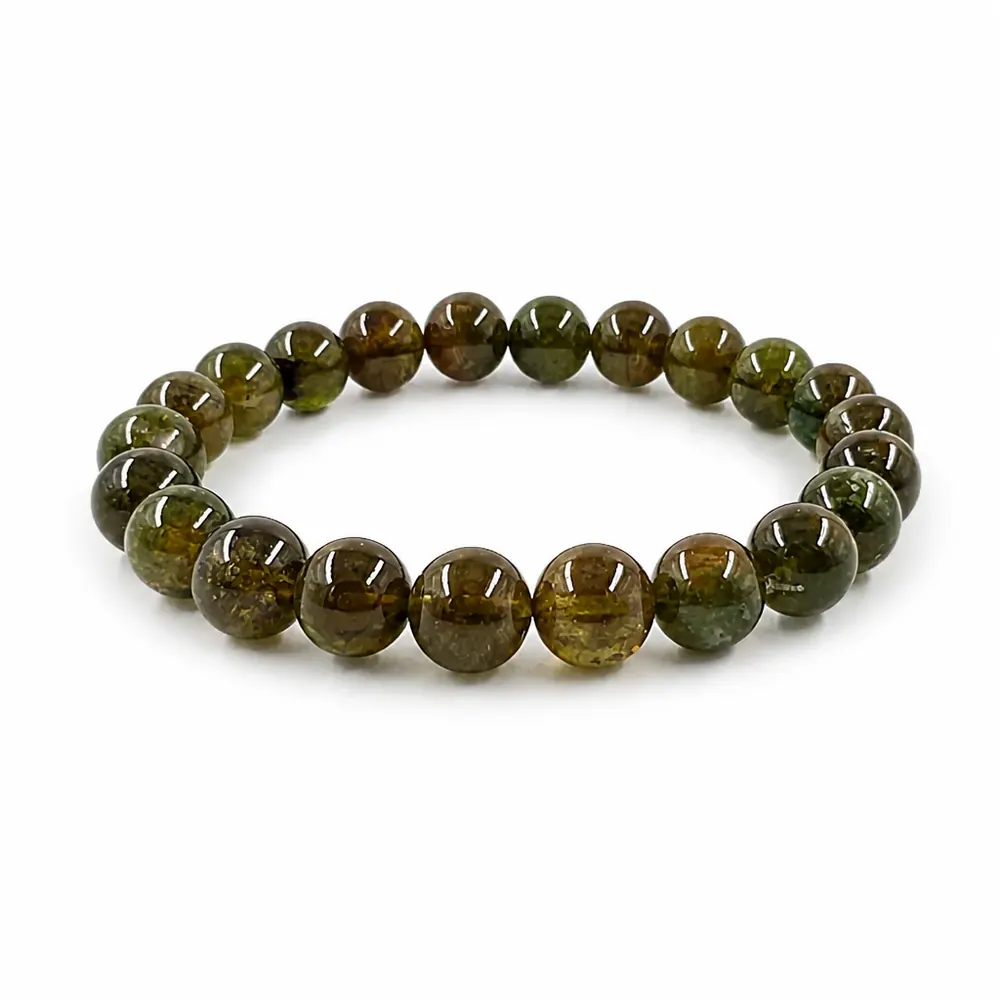
Pair a rainbow strand with moonstone for a soft, shifting stack, or wear a single-colour tourmaline with clear quartz to let its colour stand out.
Care
At 7–7.5 on the Mohs scale, tourmaline is durable for daily wear, though its natural fractures deserve a little care.
- Avoid sudden heat and ultrasonic cleaners.
- Take it off for showering, swimming and exercise.
- Perfume and lotion first — bracelet last.
- Wipe with a soft, dry cloth and store in a soft pouch.
Every tourmaline bead is cut from a different point along a crystal's colour — so no two bracelets are ever quite the same.
Our tourmaline pieces — rainbow, green and faceted — live in our shop.
See our tourmaline pieces