Sunstone
A warm shimmer that sweeps across the stone as you move — moonstone's sunlit counterpart.
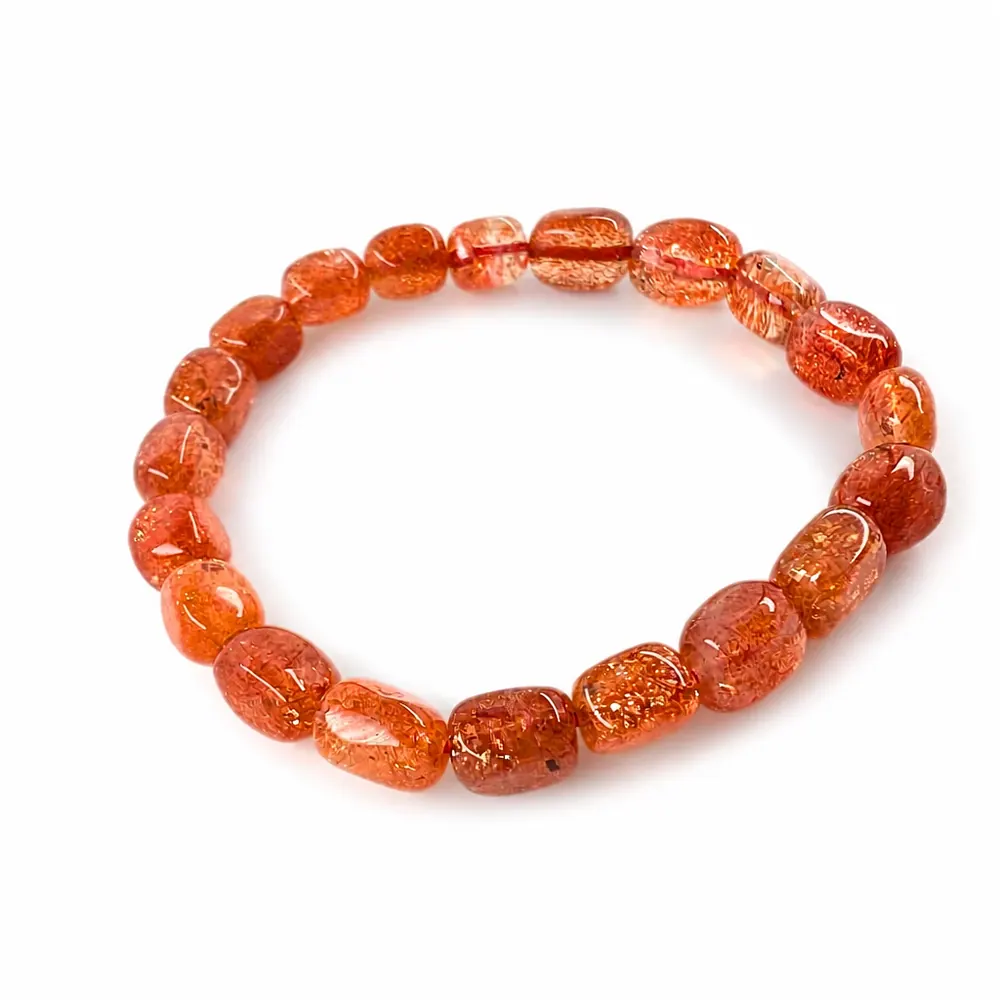
Few stones are confused with an imitation as often as sunstone. Here is what it is, how to tell it from manufactured goldstone, and how to choose and care for a piece.
At a Glance
- Mineral family
- Feldspar
- Hardness
- 6–6.5 Mohs
- Optical effect
- Aventurescence
- Colour range
- Champagne, honey, amber, red-orange
- Found in
- India, Tanzania, Norway, Madagascar, USA
What It Is
Sunstone belongs to the feldspar family — the same group that gives us moonstone and labradorite. What makes it sunstone is what grew inside it.
As the crystal cooled, microscopic metallic platelets formed along its internal planes — copper in Oregon material, hematite or goethite in stones from India and Tanzania. Light strikes those platelets and scatters back out as a warm, moving shimmer called aventurescence.
Sunstone vs Goldstone
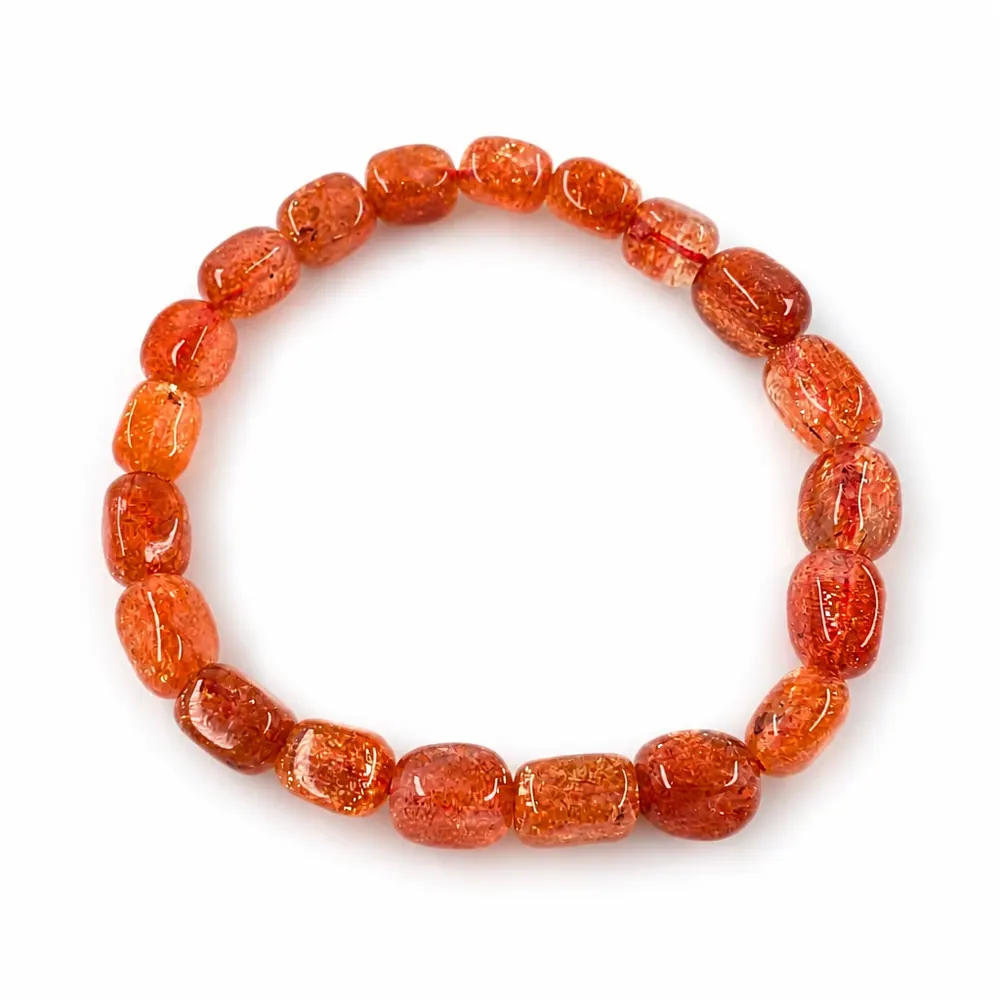
Goldstone is not a stone. It is aventurine glass, first made in Italy centuries ago, with copper crystals grown inside it during a slow cool. It is a lovely craft in its own right — the problem is only when it is sold as sunstone. You can tell them apart by eye:
The pattern of the sparkle
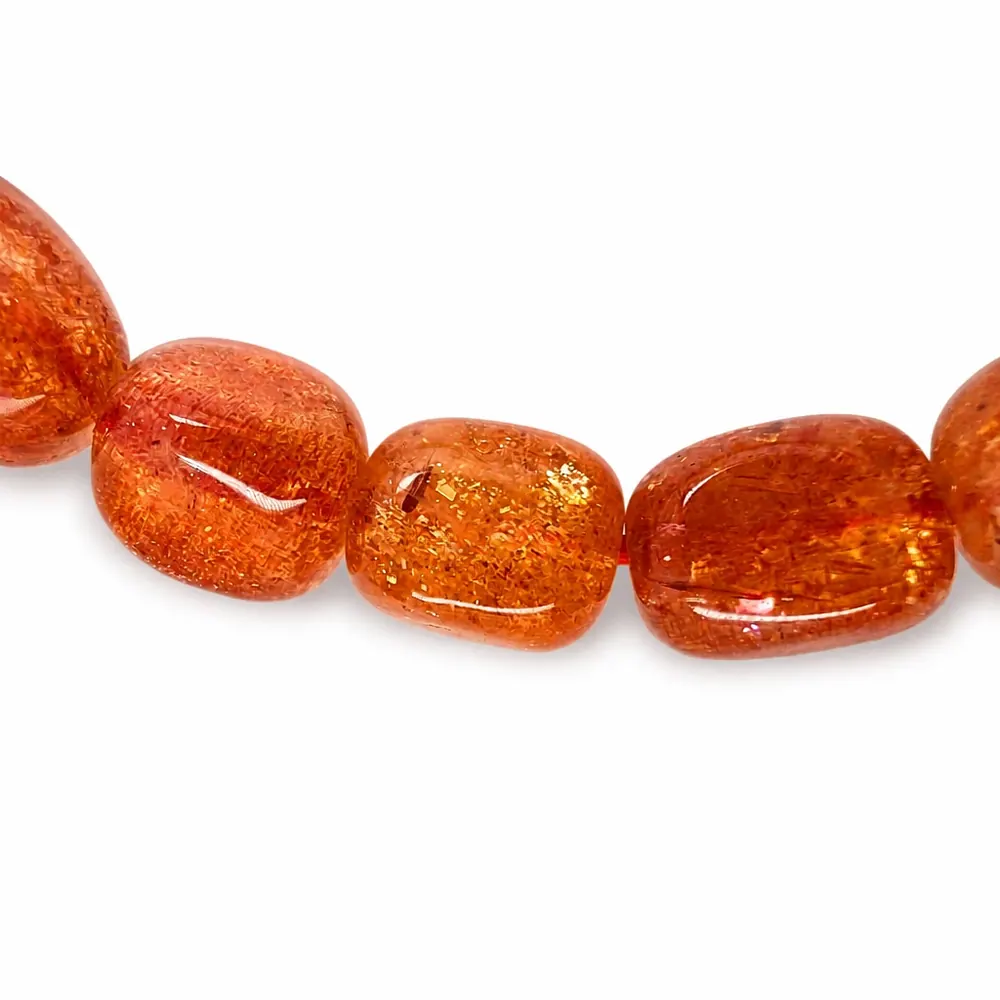
Goldstone glitters evenly — flecks of the same size at the same density. Sunstone's platelets grew unevenly, so one bead flares while its neighbour stays quiet.
Movement
Real aventurescence is directional: turn the piece and the shimmer sweeps across, then vanishes. Goldstone looks much the same from every angle.
What sits inside
Natural sunstone carries veils and small variations in clarity. Glass shows gas bubbles under a ten-times loupe and an unnaturally uniform colour.
Price
Goldstone is inexpensive to make. Large, flawlessly matched, intensely orange beads at a very low price deserve a second look.
How to Recognise Quality
Once you know it is genuine sunstone, three things separate a fine strand:
- Strength of shimmer — it should move as the bead turns, in daylight as well as under a spotlight.
- Clarity and body colour — hold it to a window; light should travel into the stone, not stop at the surface.
- A natural range — beads that vary within a range, rather than perfectly identical or wildly mismatched.
In the Crystal Tradition
Sunstone is associated with warmth and outward-facing confidence — the counterpart to moonstone's inwardness:
- Confidence — often turned to when something needs saying out loud.
- Self-worth — a steadier sense of one's own value.
- Optimism — lightness of outlook through darker stretches.
- Warmth — a companion for sociability and open connection.
Wearing & Pairing
Its warm tone sits naturally against gold and rose gold, and it flatters warmer skin tones without effort. By convention it is worn on the left wrist, though either is fine.
Pair by colour: with rabbit hair quartz for two kinds of inner light in one stack, or beside a milky moonstone as a study in warm and cool.
Care
At 6–6.5 on the Mohs scale, sunstone is softer than quartz, and feldspar can split along its cleavage planes if knocked.
- Take it off before anything strenuous.
- Brief contact with water is fine; avoid soaking and ultrasonic cleaners.
- Perfume and lotion first — bracelet last.
- Store apart from harder stones; wipe with a soft, dry cloth.
The difference between sunstone and goldstone is not really about value. It is about knowing what you are wearing.
Our sunstone bracelets — single-stone and paired with rabbit hair quartz — live in our shop.
See our sunstone pieces