
Hypersthene
Plain dark stone at a glance — until the light finds it, and a silver sheen slides across.
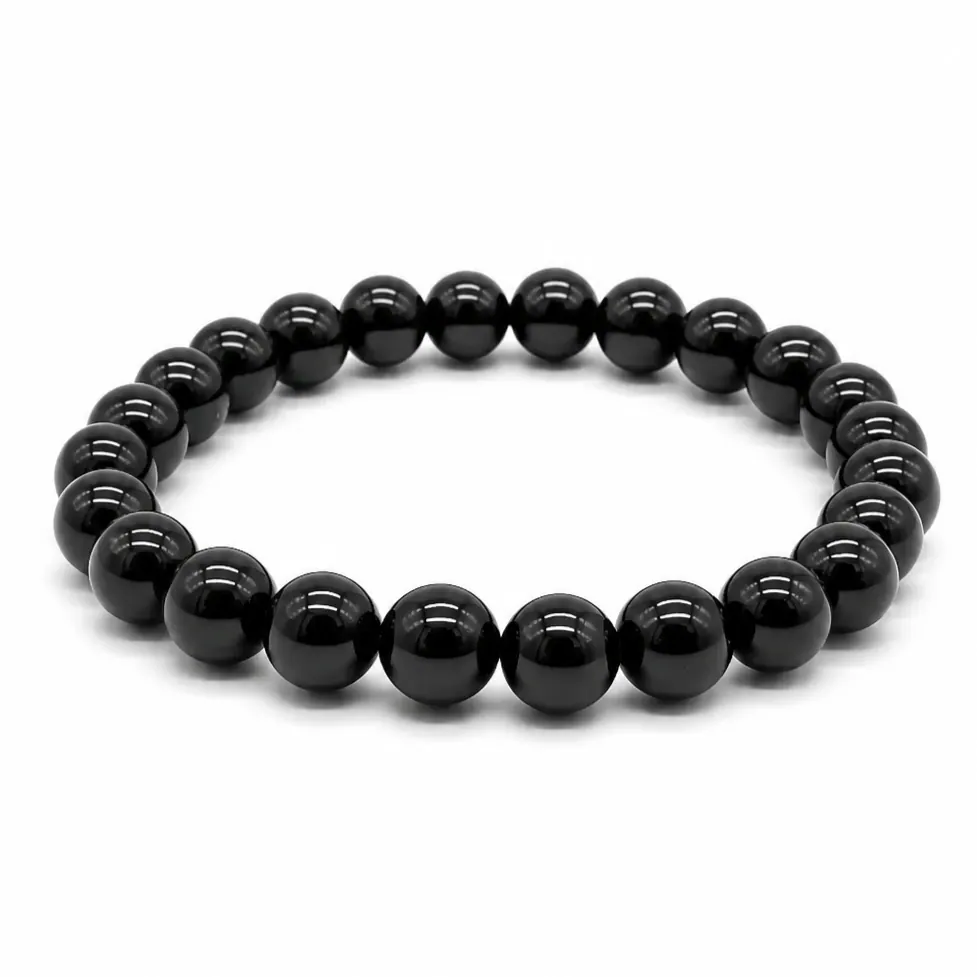
Hypersthene rewards patience more than most stones. Here is what it is, what causes its sheen, how to tell it from the black stones it is often confused with, and how to look after it.
At a Glance
- Mineral family
- Pyroxene (orthopyroxene)
- Hardness
- 5–6 Mohs
- Optical effect
- Schiller
- Colour range
- Brown-black to deep grey, silver to bronze sheen
- Main sources
- India, Canada, Greenland, Norway
What It Is
Hypersthene is a magnesium-iron silicate from the pyroxene family. Strictly, mineralogists retired the name in 1988 — the material is now called ferroan enstatite — but the trade name has stayed in use almost everywhere.
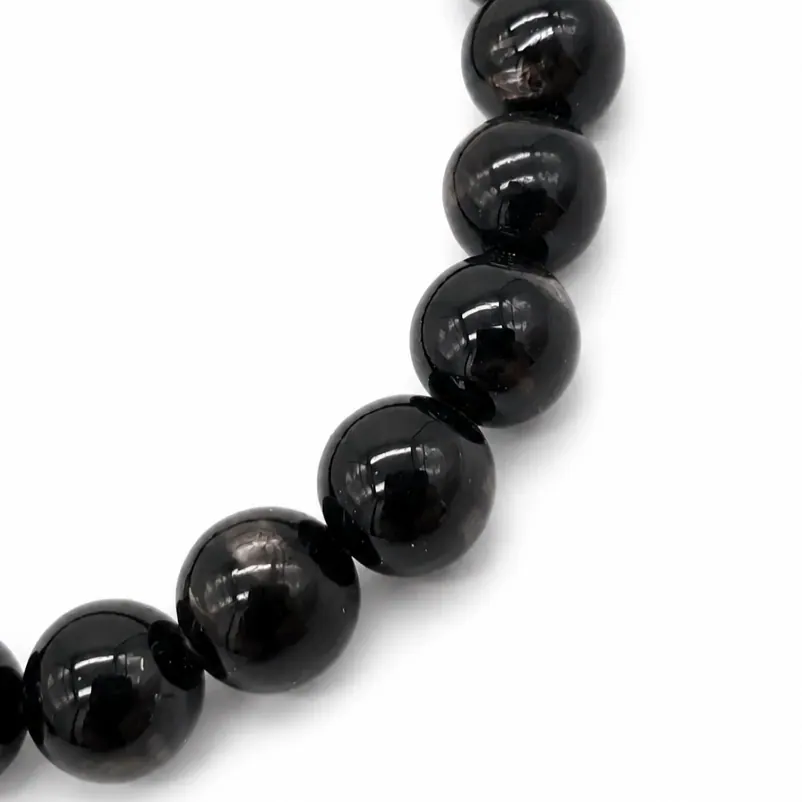
Its signature is schiller, from the German for shimmer. As the mineral cooled, microscopic plates of iron-titanium oxides settled in parallel layers inside it. Light reflects off those aligned plates all at once, and the eye reads a single sheet of light floating just below the surface.
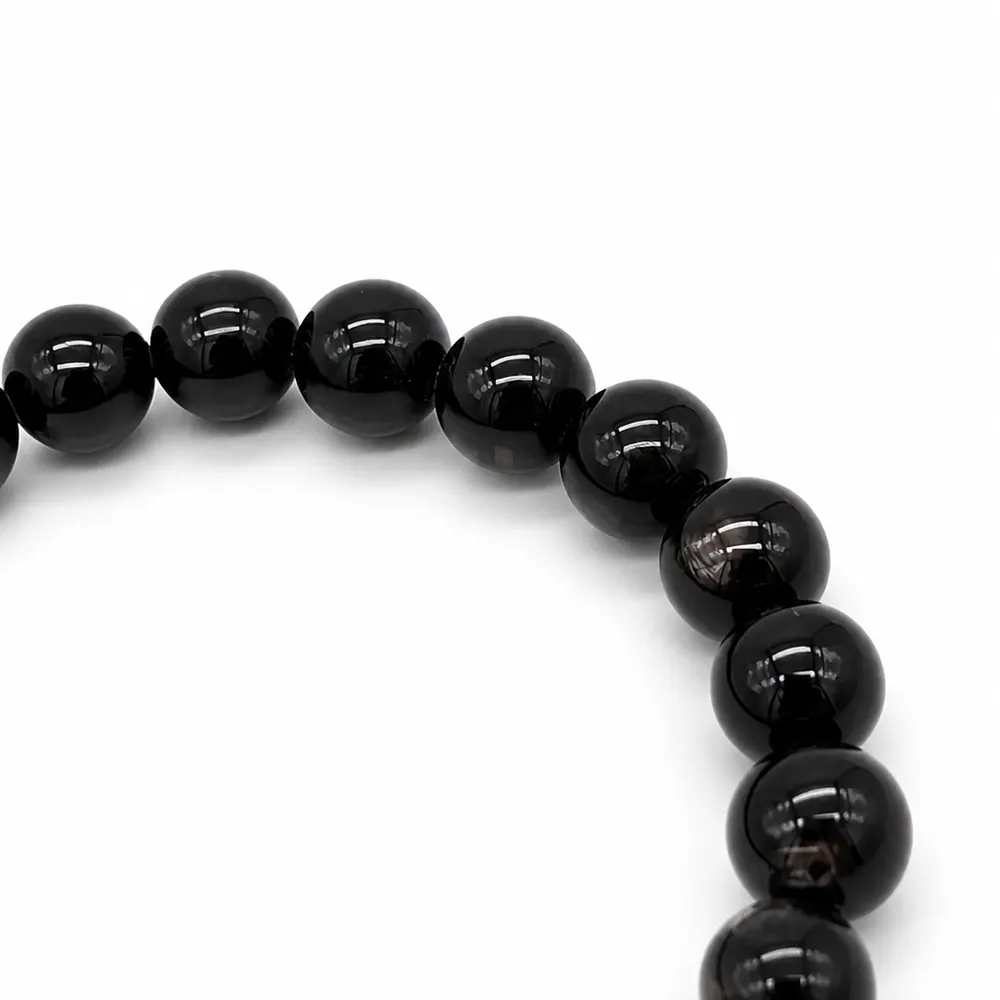
Because the plates are aligned, the effect is directional: turn a bead and the sheen appears, travels across the curve, and disappears. It is silver-grey, sometimes warming to bronze — never rainbow-coloured.
Hypersthene or Look-Alike?
- Sheen obsidian — the closest imitator. Its sheen comes from gas bubbles, sits as a broad velvety wash rather than a moving band, and the glass feels warmer in the hand.
- Black tourmaline — no sheen at all, with fine lengthwise striations, and noticeably harder.
- Labradorite — flashes blue, green and gold, colours hypersthene does not produce.
- Dyed onyx, glass and resin — flat and uniform, with no internal movement, and often an identical pattern bead to bead.
How to Recognise Quality
Directional light
Take it to a window or a single lamp and turn it slowly. Genuine schiller moves; a coated sparkle stays put. Diffuse overhead light hides the effect entirely.
Not every bead at once
On a natural strand, the plates sit at different angles in each bead, so only some catch the light at a time. Every bead flashing identically is a warning sign.
Depth, not glitter
Better material shows a broad, coherent sheet of light with a soft edge. Hold it against a dark background to see it clearly.
Drilling and cord
Clean, centred holes without chipping, and beads that sit flush against one another.
In the Crystal Tradition
Hypersthene is associated with settling, steadying qualities:
- Grounding — turned to when the day has run away with itself.
- Focus — holding attention on one task at a time.
- Quiet confidence — many wearers reach for it before conversations they have been putting off.
- Rest — some keep a piece by the bedside at the end of a long week.
Wearing & Pairing
Hypersthene gives nothing away across a room and everything at arm's length — which is why it suits people who would rather not announce what they are wearing. It sits well with silver and with grey, black or white clothing.
Care
At 5–6 on the Mohs scale, hypersthene is softer than quartz, and its sheen depends on a good polish.
- Put it on last — perfume, hairspray and lotion dull the polish.
- Avoid soaking; water in the drill holes weakens the cord.
- Store it apart from quartz, tourmaline and onyx, which will scuff it.
- Wipe with a soft, dry cloth after wearing.
Held still, it reads as plain dark stone. Tilt it towards a window, and something else appears.
Our hypersthene bracelets live in our shop.
See our hypersthene pieces